
The Trust Signals Are There, But Not Where Shoppers Need Them
Banu Skin shows how shipping promises, return terms, missing size details, and buried credibility signals can create trust gaps at the buy button.

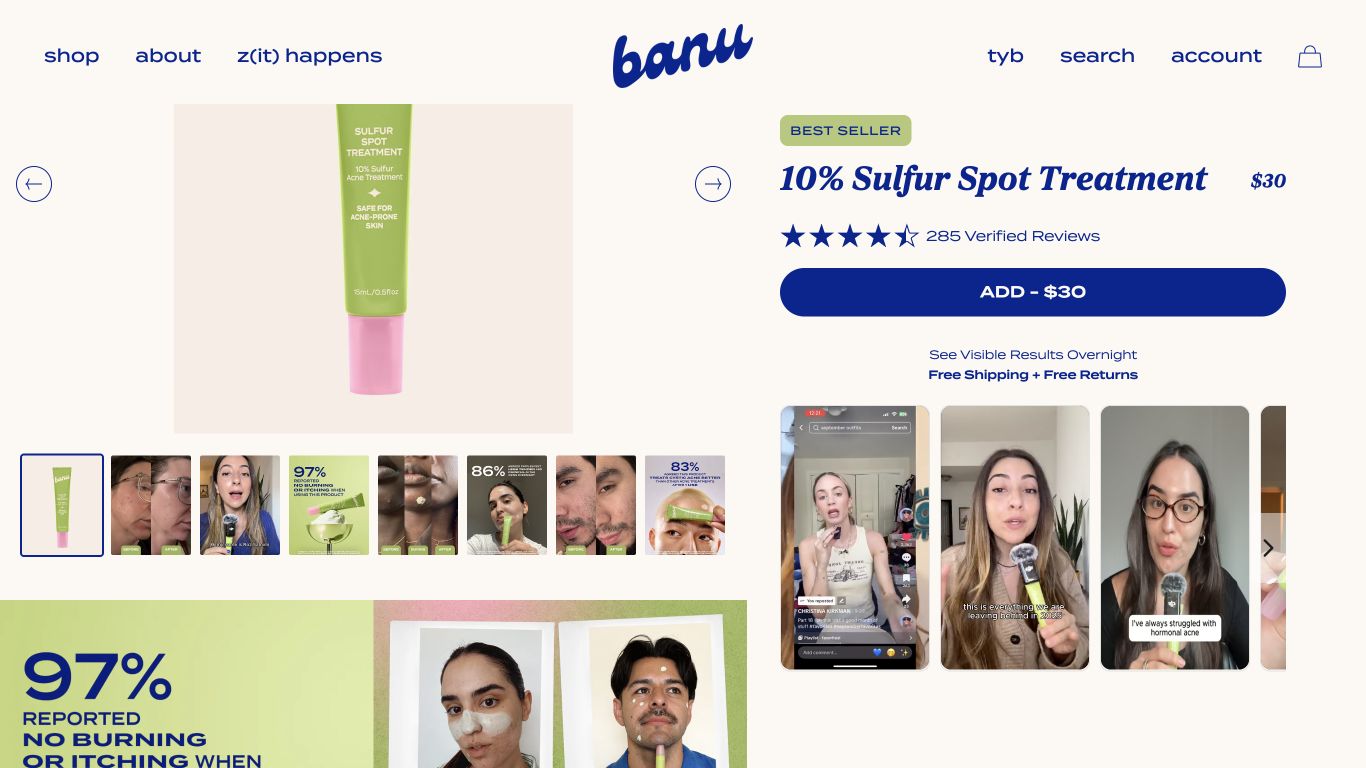
Banu Skin has a bright visual system, clear acne-safe positioning, and credible proof assets. The audit found a narrower problem: several trust signals show up without the condition, policy detail, or product context a shopper needs at the buy button.
This is not a takedown. It is a useful pattern study because Banu Skin already has the material to build trust; the opportunity is putting that material where the decision happens.
The teardown in one sentence
Banu Skin's biggest leak is not missing credibility. It is that the credibility does not always travel with the condition, the policy, or the product detail a deliberate skin-care shopper needs at the moment of purchase.
That matters because skin care is a high-scrutiny category. Shoppers are not only buying a tube or serum. They are deciding whether the brand will be precise with claims, policies, and expectations before they put the product on their face.
The shipping promise is bigger than the policy
On the Sulfur Spot Treatment page, the buy box makes a clean promise: "Free Shipping + Free Returns." It sits directly under the $30 add-to-cart button, which is exactly where a shopper is deciding whether the order feels low risk.
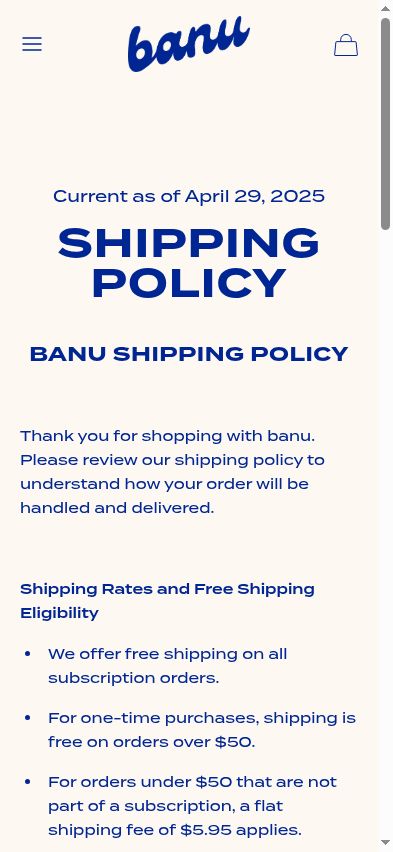
The shipping policy adds the condition. Subscription orders get free shipping. One-time orders get free shipping over $50. One-time orders under $50 that are not part of a subscription get a $5.95 flat shipping fee.
That does not mean the policy is unfair. The problem is placement. The product-page promise reads unconditional, while the policy is conditional. If a shopper believes the buy-box promise and then sees the condition later, the brand has turned a trust signal into a reconciliation task.
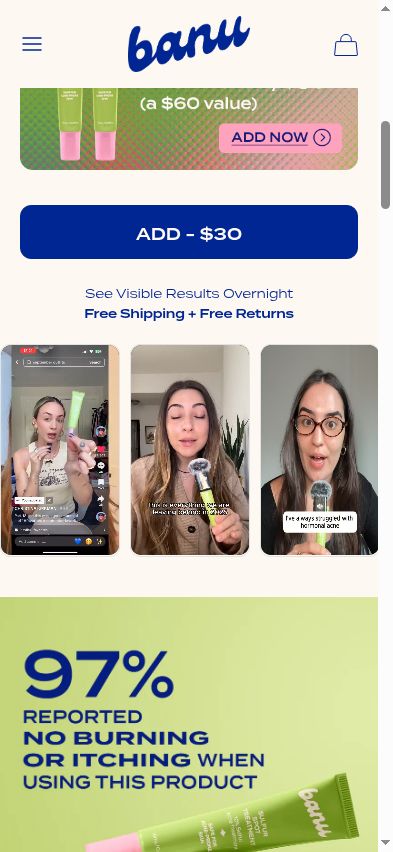
There is also a missed upside here. The policy says subscriptions receive free shipping, but the captured product page shows a one-time add button instead of a subscription choice near the buying controls. If subscription is a real purchase path, the page could make that benefit visible at the moment when shipping cost is most relevant.
The fine print arrives after the promise
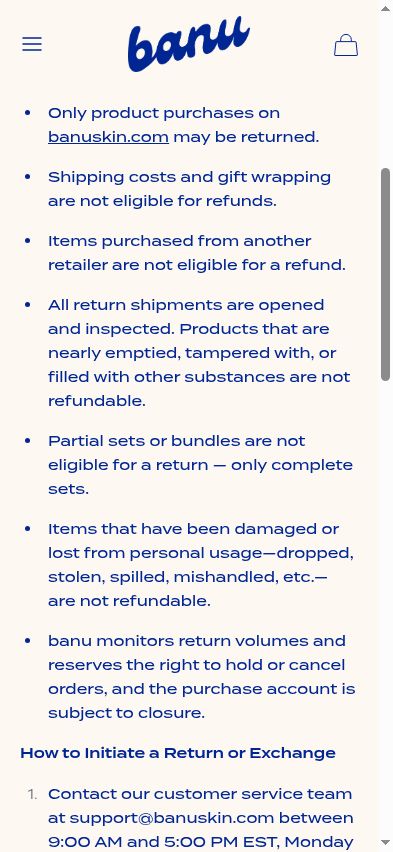
"Free Returns" works the same way. The product page makes the promise near the buy button. The return policy later explains that Banu monitors return volume, may hold or cancel orders, and that the purchase account is subject to closure.
Those conditions may be reasonable. They are still conditions. For a shopper evaluating acne or sensitive-skin products, returns are not an abstract perk. They are part of the risk calculation. A short "see terms" link or tighter qualifier near the promise would make the guarantee feel more precise instead of less trustworthy.
The same pattern appears in product detail. The Dark Spot Milky Serum page shows a $54 price and the add button, but the visible decision area does not state how much product the shopper receives. The amount may be visible in product imagery elsewhere, but it is not presented as plain text where the value judgment happens.
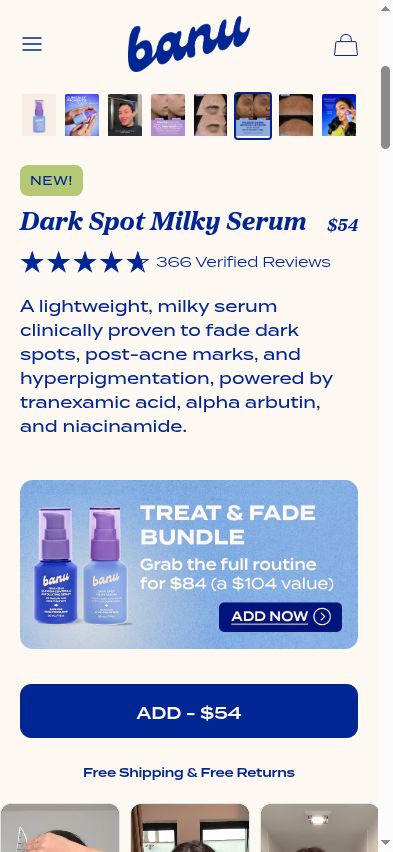
None of this requires a redesign. It is mostly about keeping the promise and the qualifier in the same place. If the shopper has to leave the buy box to understand the real terms, the buy box is doing less work than it should.
Credibility is present, but not always placed at the decision
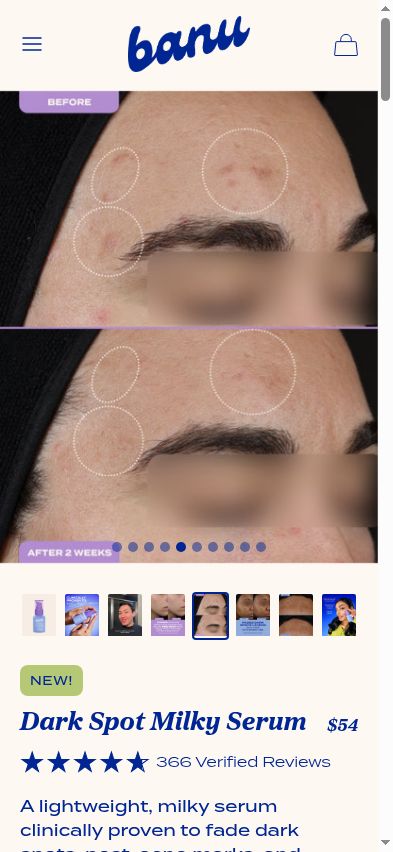
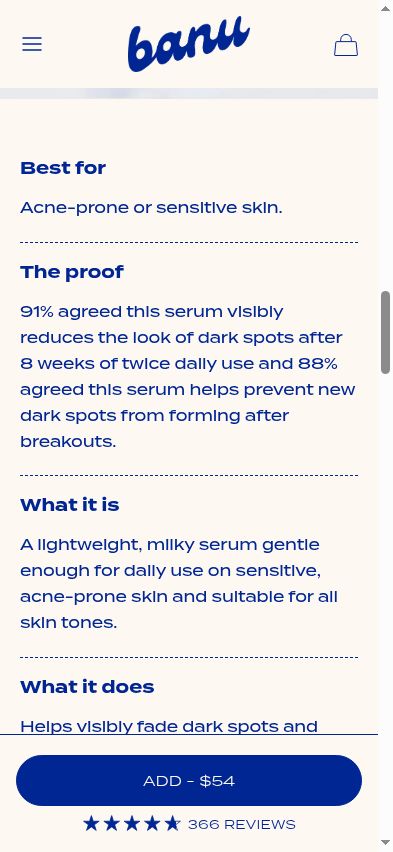
Banu Skin has proof. The Dark Spot Milky Serum gallery includes a before/after image labeled "AFTER 2 WEEKS." Lower on the page, the proof section says 91% agreed the serum visibly reduces the look of dark spots after 8 weeks of twice-daily use.
Both assets can be useful. Side by side, they ask for a clearer bridge. The gallery creates a fast result expectation; the proof section sets the broader clinical timeline. A short caption under the 2-week image could keep the dramatic visual while making the result expectation more precise.
The same placement issue shows up with third-party credibility. In the captured flow, the Sephora link appears inside the footer SHOP accordion. The homepage hero shows Women's Health, Cosmopolitan, and PopSugar award badges, but the Sephora signal is not carried into the same first-screen credibility area.
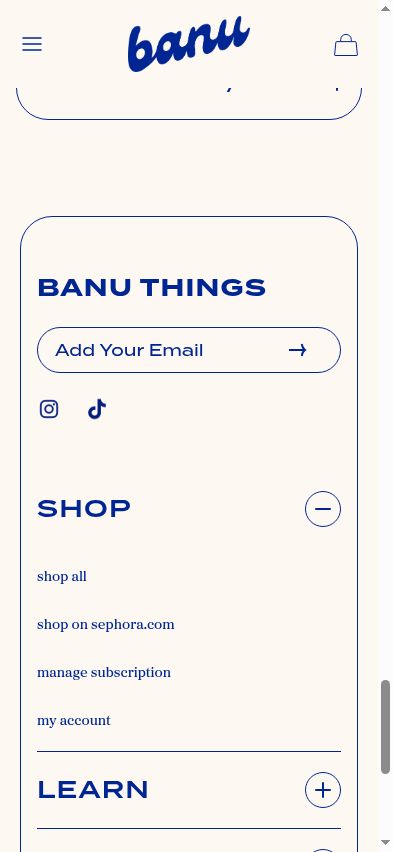
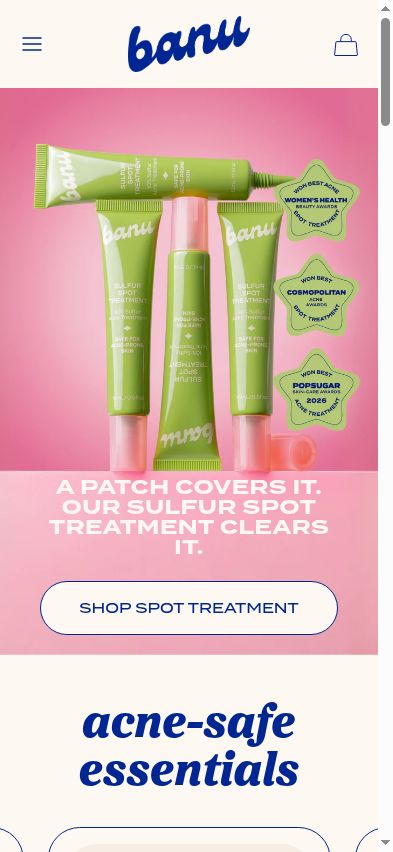
That is not a content shortage. It is a placement problem. The store already has credibility. The page just needs to put the right proof beside the moment it is meant to support.
What Banu Skin could test
- Qualify the product-page trust copy so "Free Shipping" travels with the subscription or $50 threshold.
- Add a subscription option or subscription-free-shipping callout near the add-to-cart button if that purchase path is active.
- Put the return-policy qualifier near "Free Returns," either as short copy or a linked "see terms" line.
- Add product size or volume as plain text near price on the main product pages.
- Add an expectation-setting caption under the 2-week before/after image so it aligns with the 8-week proof claim.
- Surface "also available at Sephora" on product pages or the homepage trust area instead of leaving it only in the footer.
The lesson for every store
Trust signals do not work by existing somewhere on the site. They work when they answer the shopper's question at the moment the question appears.
For Banu Skin, the questions are straightforward. Does this $30 order ship free? What does "free returns" really include? How much serum am I getting for $54? Should I expect visible change in 2 weeks or 8 weeks? Has a retailer I trust already vetted this brand?
The store already has material to answer those questions. The next step is making sure every promise carries its condition, every proof point carries its context, and every credibility signal shows up where the shopper is making the decision.
Findings here reflect what we observed during our audit. Live sites change over time, so treat this as a study of a pattern, not a verdict.

See what deserves your attention first
Start with a free scan and get a revenue-ranked view of the conversion opportunities worth investigating.
Free baseline audit · No credit card · Optional free-trial follow-up